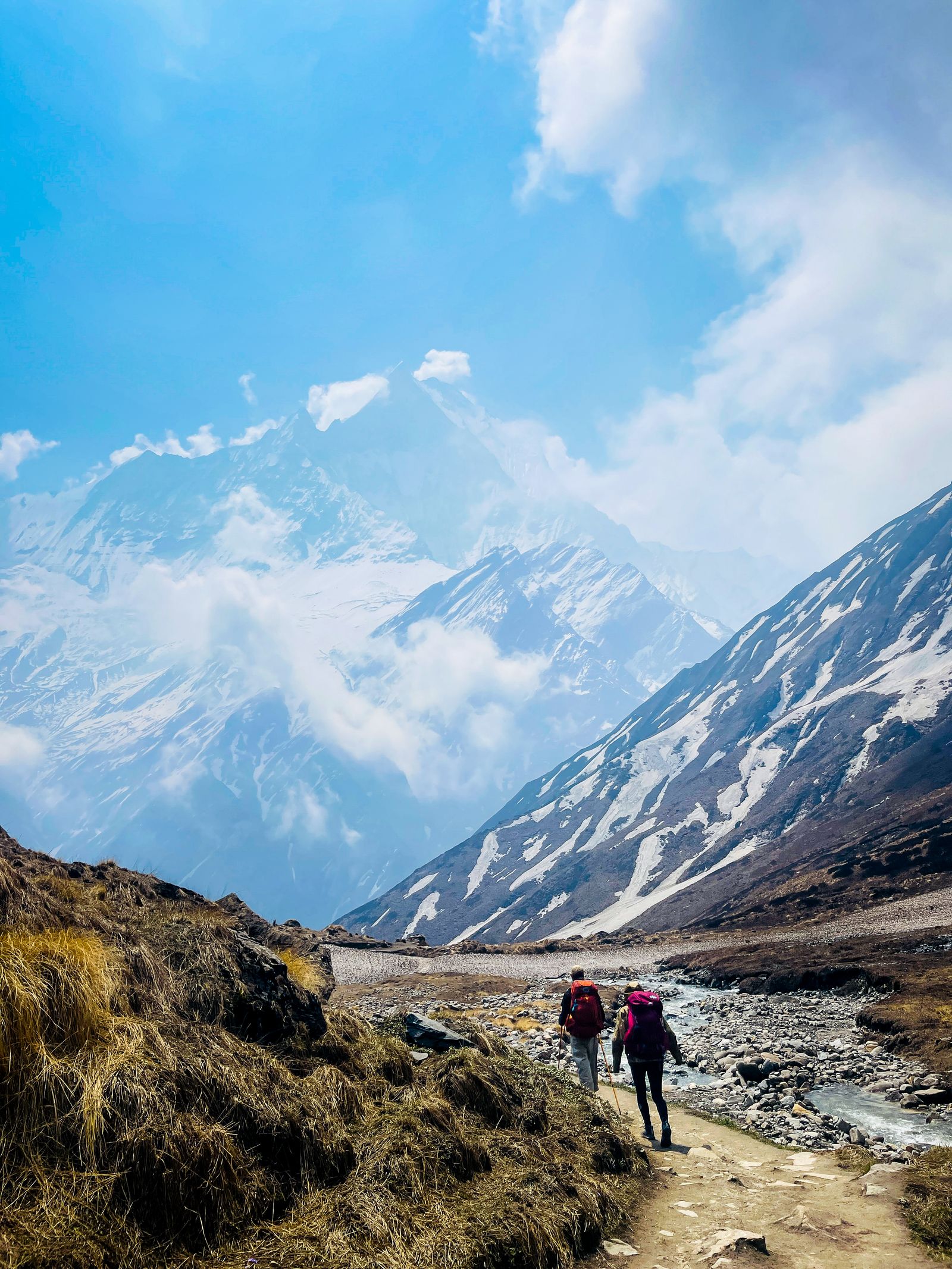
Overview
Short answer: most Nepal treks need two permits — an entry permit for the national park or conservation area you walk into (NPR 3,000 for foreigners in the Annapurna, Everest and Langtang regions) and a TIMS card at NPR 2,000, issued online by a registered trekking agency. Restricted areas need a third, costlier permit from the Department of Immigration.
Before you travel: permit rules and fees change, and different official pages sometimes disagree. Confirm with the issuing authority — the Nepal Tourism Board for TIMS and park fees, the Department of Immigration for restricted areas — before you book. Every figure here was checked against the source cited beside it on 28 July 2026.
Which permits do I need to trek in Nepal?
Think of it as up to three separate layers, each issued by a different body:
- A protected-area entry permit — the national park, conservation area or wildlife reserve you enter. One per area crossed.
- A TIMS card — the Trekkers' Information Management System registration, run by the Nepal Tourism Board.
- A restricted-area permit — only for the fifteen sensitive regions listed further down, and only issued through a registered trekking agency.
Your tourist visa is a separate matter entirely. Holding a 90-day visa does not entitle you to walk anywhere; holding permits does not extend your visa.
Do I need a TIMS card, and how much does it cost?
Yes, on the routes the Nepal Tourism Board lists as mandatory. Under the revised TIMS provision effective 31 March 2023, the card is issued by a registered trekking agency rather than sold over a counter to individuals, and it arrives as an eCard with a QR code.
| TIMS card | Fee |
|---|---|
| SAARC nationals | NPR 1,000 per trekker |
| All other nationalities | NPR 2,000 per trekker |
The Board's wording is exact: "For charges, NPR 1,000 for SAARC (Citizens of South Asian countries) country applicants and for others NPR 2,000 and, currently payable online." Source: Nepal Tourism Board, TIMS Card, checked 28 July 2026.
Note what is no longer true: the old four-tier pricing — a cheaper "blue" group card, a dearer "green" independent-trekker card, and NPR 300 and NPR 600 SAARC rates — is gone. Many trekking blogs still quote it. Take the Tourism Board's figure.
Is a guide mandatory for trekking in Nepal?
On the routes the Nepal Tourism Board lists, yes. Its published position is that "specific Protected Areas of Nepal need trekker to be accompanied by licensed trekking guide and carry a trekking agency issued TIMS Card." The route list covers most of what people come to Nepal to walk:
- Everest region — Everest Base Camp, Gokyo, Cho La Pass, Renjo La, Three Passes, Everest View, Mera Peak, Amphu Labtsha.
- Annapurna region — Annapurna Circuit, Nar Phu, Tilicho/Mesokanto, Poon Hill–Annapurna Base Camp, Khopra, Mardi Himal.
- Langtang and Helambu — Langtang, Gosaikunda, Tamang Heritage, Ganja La.
- Kanchenjunga, Makalu Barun, Rolwaling, Manaslu, Tsum, Mustang, Dhaulagiri, Dolpo, Humla and the Ganesh Himal–Ruby Valley.
Being straight with you: that is the legal position as published. No government source states how the rule is enforced, what a penalty would be, or how consistently checkposts apply it, and the Tourism Board's own link to the original 2023 press release is broken. Claims circulating online that the requirement has been dropped for the Everest or Annapurna regions are contradicted by the Board's current page. Plan on needing a guide, and treat any advice that you can skip it as unverified.
How much are national park and conservation area entry permits?
| Protected area | Foreigners | SAARC | Nepali |
|---|---|---|---|
| Sagarmatha National Park (Everest) | NPR 3,000 | NPR 1,500 | NPR 100 |
| Annapurna Conservation Area (ACAP) | NPR 3,000 | NPR 1,000 | NPR 100 |
| Langtang National Park | NPR 3,000 | NPR 1,500 | NPR 100 |
| Manaslu Conservation Area (MCAP) | NPR 3,000 | NPR 1,000 | NPR 100 |
| Gaurishankar Conservation Area | NPR 3,000 | NPR 1,000 | NPR 100 |
| Makalu-Barun National Park | NPR 3,000 | NPR 1,500 | NPR 100 |
| Shey-Phoksundo National Park (Dolpo) | NPR 3,000 | NPR 1,500 | NPR 100 |
| Kanchenjunga Conservation Area | NPR 2,000 | NPR 500 | NPR 100 |
| Chitwan National Park | NPR 2,000 | NPR 1,000 | NPR 150 |
| Shivapuri-Nagarjun National Park | NPR 1,000 | NPR 600 | NPR 100 |
All rates are per person, per entry, and children below 10 enter free in every one of these areas. Source: Nepal Tourism Board, Park Entry Fees, checked 28 July 2026. The Board notes that its table reproduces figures supplied by the responsible department, so treat the department's own counter as final.
One route needs two of these: the Manaslu Circuit starts inside the Manaslu Conservation Area and finishes inside the Annapurna Conservation Area, so budget for both permits and ask your agency to confirm.
Which treks need a restricted-area permit, and what does it cost?
Fifteen regions are classed as restricted. The Department of Immigration is unambiguous that these permits are issued only through a registered trekking agency — the process is now entirely online through the Nepali Port portal, and an individual cannot apply directly. Fees are charged in US dollars on top of your park or conservation permit.
| Restricted area | Permit fee (USD, per person) |
|---|---|
| Upper Mustang | US$50 per day |
| Upper Dolpa | US$500 for the first 10 days, then US$50 per day |
| Manaslu (Gorkha) | Sep–Nov: US$100 per week, then US$15 per day. Dec–Aug: US$75 per week, then US$10 per day |
| Tsum Valley (Gorkha) | Sep–Nov: US$40 per week, then US$7 per day. Dec–Aug: US$30 per week, then US$7 per day |
| Nar–Phu (Manang) | Sep–Nov: US$100 per week, then US$15 per day. Dec–Aug: US$75 per week, then US$15 per day |
| Lower Dolpa | US$20 per week, then US$5 per day |
| Humla | US$50 per week, then US$10 per day |
| Taplejung (Kanchenjunga), Sankhuwasabha, Solukhumbu | US$20 per week for the first 4 weeks, then US$25 per week |
| Rasuwa (Gosaikunda RM), Dolakha | US$20 per week |
| Mugu | US$100 per week, then US$15 per day |
| Bajhang, Darchula | US$90 per week, then US$15 per day |
Source: Department of Immigration, Trekking Route and Permit Fee, checked 28 July 2026. Restricted areas are defined by ward, not by trail name, so the exact wards each fee covers matter — check the Department's table with your agency before paying.
Two things worth knowing. The Department adds that for Upper Mustang and Upper Dolpa, "if the royalty paid for a mountain expedition is less than the trekking permit fee, the difference amount must be paid separately." And the Tourism Board and TAAN both publish Upper Mustang and Upper Dolpa figures that differ from the Department's. The Department of Immigration issues the permit, so its table is the one that will be charged.
What does an agency need from you for a restricted-area permit?
Your passport and valid visa, a trekker list, insurance documents for the trekkers and for the guides and porters, and a detailed itinerary on the agency's letterhead. Applications completed and paid at least an hour before closing are processed the same day. Source: Department of Immigration, checked 28 July 2026.
The classic routes at a glance
| Trek | Typical length | Permits |
|---|---|---|
| Ghorepani–Poon Hill | 4–5 days | ACAP + TIMS |
| Mardi Himal | 5–7 days | ACAP + TIMS |
| Annapurna Base Camp | 7–12 days | ACAP + TIMS |
| Langtang Valley | 7–10 days | Langtang NP + TIMS |
| Everest Base Camp | 12–14 days | Sagarmatha NP + local Khumbu fee + TIMS |
| Annapurna Circuit | 12–18 days | ACAP + TIMS |
| Manaslu Circuit | 14–18 days | Restricted permit + MCAP + ACAP |
| Upper Mustang | 10–14 days | Restricted permit + ACAP |
The Everest region also levies a local municipal fee collected in the Khumbu, separate from the national park permit — ask your agency for the current amount, since it is set locally rather than by the national schedule.
When is the best time to trek in Nepal?
Autumn (late September–November) brings the clearest air and the most settled weather, and it is busy for exactly that reason. Spring (March–May) is warmer, with rhododendron forests in flower, and is the main climbing season. During the monsoon (June–September) the trails are wet and views are unreliable, but the rain-shadow regions of Mustang and Dolpo stay dry — which is why their restricted-area fees drop outside September–November. Winter (December–February) is clear and cold, with high passes liable to close under snow. Our month-by-month guide to the best time to visit Nepal has the rainfall and temperature figures behind all of this.
How do I avoid altitude sickness?
This is the part of trek planning worth taking seriously. The US CDC's Yellow Book is blunt about Nepal specifically: "Itineraries along some trekking routes in Nepal, particularly Everest base camp, push the limits of many people's ability to acclimatize. Even on standard acclimatization schedules, the prevalence of altitude illness can approach 30% at higher elevations."
Its practical rules:
- Above 3,000 m, gain no more than 500 m of sleeping altitude per day, and add an extra acclimatisation day for every 1,000 m gained.
- Do not go from below 1,200 m to a sleeping altitude above 2,750 m in a single day — worth remembering when a flight or jeep can deliver you straight to altitude.
- Acute acclimatisation takes 3–5 days. Anyone sleeping at 2,450 m or higher without acclimatising is at risk, and fitness does not protect you.
- Avoid alcohol and hard exercise for the first 48 hours at altitude.
Source: CDC Yellow Book 2026, High-Altitude Travel and Altitude Illness, checked 28 July 2026. Everest Base Camp itself sits at approximately 5,400 m by the CDC's figure. Carry insurance that explicitly covers high-altitude trekking and helicopter evacuation — and read the altitude limit written into the policy, because cover is usually capped at a stated elevation.
Frequently asked questions
How much does a TIMS card cost in 2026?
NPR 2,000 per trekker, or NPR 1,000 for citizens of SAARC countries, payable online through a registered trekking agency.
Can I get trekking permits myself, without an agency?
Not for TIMS, which the Tourism Board now issues to agencies rather than to individuals, and not for restricted areas, where the Department of Immigration issues permits only through a registered agency. Park and conservation-area entry permits are paid per entry.
Do I need a guide for Everest Base Camp?
The Nepal Tourism Board lists Everest Base Camp among the routes requiring a licensed guide and an agency-issued TIMS card. Reports that the rule was dropped are contradicted by the Board's current page.
How much are Everest permits altogether?
Sagarmatha National Park entry is NPR 3,000 for foreigners, plus a TIMS card at NPR 2,000, plus the locally collected Khumbu municipal fee.
Do children pay park entry fees?
No. Children below 10 enter every national park, wildlife reserve and conservation area in Nepal free.
Why is the Manaslu permit cheaper in winter?
Restricted-area fees for Manaslu, Tsum and Nar–Phu are seasonal: the higher rate applies September to November, the lower rate December to August.
Is trekking insurance compulsory?
For restricted-area permits, yes in effect — the Department of Immigration's checklist requires insurance documents for trekkers and for guides and porters. We found no equivalent published requirement for other routes, but a helicopter evacuation is not something to self-fund.
Planning the rest of the trip
Permits are the easy part once you know the numbers. For getting to the trailhead, see getting around Nepal, and when you come back down you can compare guided treks and tours or find a place to stay on Travia in your own currency.
Rules and fees change — confirm with the official source before travelling. The authorities here are the Nepal Tourism Board and Nepal's Department of Immigration. Reviewed by Travia Editorial on 28 July 2026.
Comments
Public — everyone on this page can read them. Tag people and businesses with @.
Comments
Sign in to comment.